See what is happening. Decide what needs doing. Follow it through to the fix.
VillageOne brings the territory, assets, equipment, investments, citizen reports and public services into a single system. The city hall sees the current situation, identifies problems, assigns responsibilities and follows every intervention through to the final result.
A public demonstration built on the data of a model commune (rural municipality).
The information exists.
VillageOne turns it into action.
In a commune, information is spread across documents, spreadsheets, phones, different systems and the experience of the people in the city hall. So a problem can be known about but hard to follow: who is responsible, what was decided, what the deadline is and whether the intervention was completed.
VillageOne links this information into a single flow. Every problem gets a person responsible, a deadline, a decision and a result that can be checked.
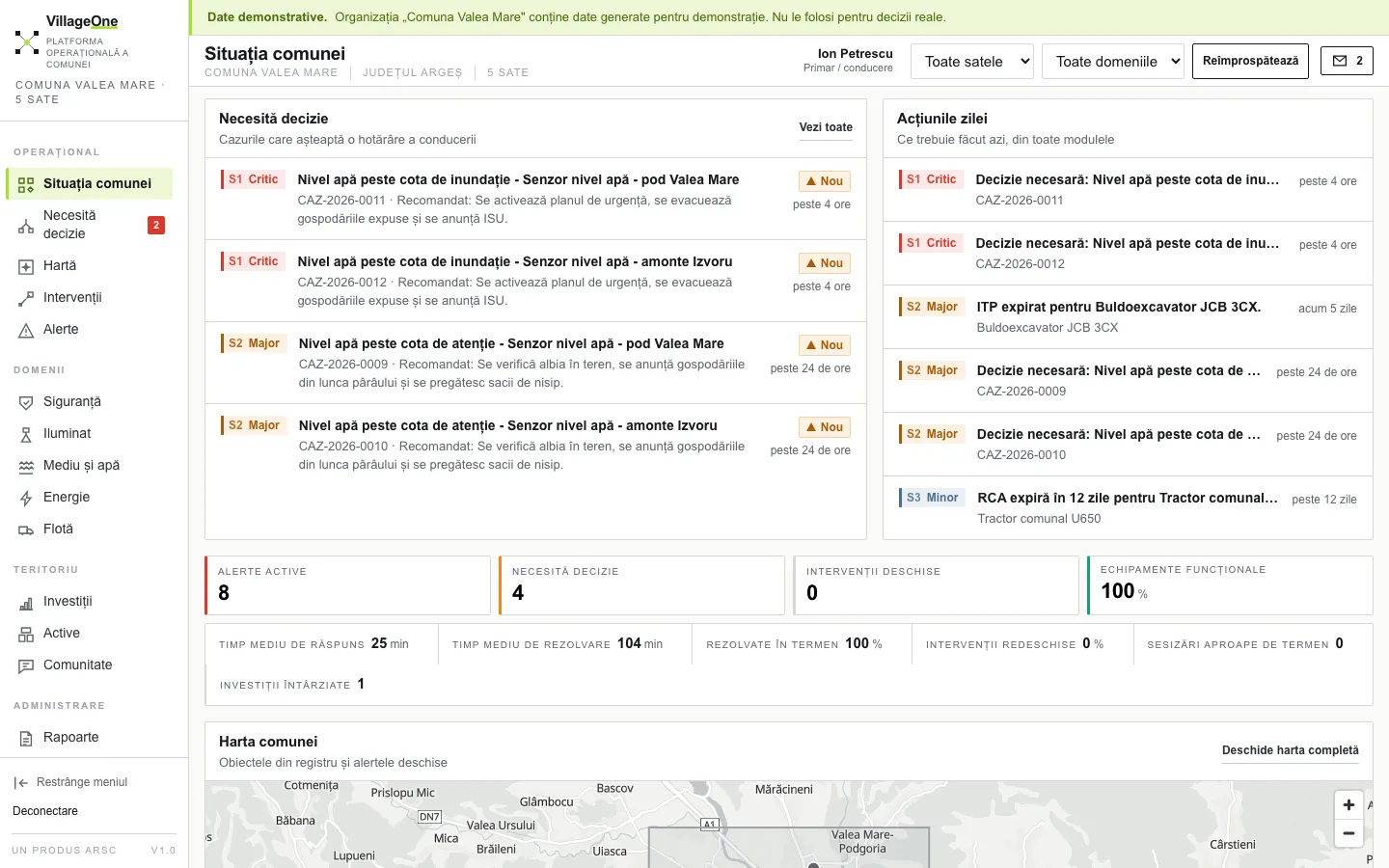
The state of the commune, in one place
The leadership sees the active problems, risks, works, investments and deadlines that need attention.
Clear accountability
Every decision and intervention has a person responsible, a deadline and a history of actions.
Followed through to the result
A citizen report or an alert does not disappear once it is logged. It stays in the loop until the fix has been checked.
Implementation tailored to the commune
The commune activates only the functions it needs and can extend the platform as new data, projects and equipment come in.
From what happens on the ground
to a verified fix.
VillageOne links information, decision and intervention in a single loop. The administration can see not only what problem exists, but also what has been done to solve it.
- 01
Status
What is happening now across the territory, in services, with assets, investments and equipment.
- 02
Deviation
What is not working normally, or what needs the administration's attention.
- 03
Risk
How important the problem is and what consequences it may have if nobody intervenes.
- 04
Decision
What needs to be done, who approves it and what information the decision rests on.
- 05
Action
Who intervenes, what the deadline is and what resources are needed.
- 06
Result
What was solved, when the intervention ended and what evidence was recorded.
One platform,
the right access for each role.
VillageOne is used by the commune's leadership, administrative staff, field teams, LAG operators and citizens. Each user sees and can change only the information they have rights to.
The commune's leadership
The mayor and the leadership see the overall state of the commune, the important problems, risks, investments, deadlines and the decisions that need to be taken.
Administrative staff
City hall officers manage citizen reports, assets, documents, projects, interventions and public services. Tasks can be assigned by domain and by the villages each user is responsible for.
Field teams
Staff in the field receive the interventions, record progress and attach photos, documents and other evidence of the work done.
The Local Action Group
The LAG can follow the development of the territory through aggregated indicators and joint projects. Each commune's internal data stays separate and is shared only under the agreed rules.
The citizen
Citizens can send and track a report through the public portal, without an account and without installing an app.
From a single commune
to the whole territory of a LAG.
VillageOne can be implemented for one commune, for several communes working together or for the whole territory of a Local Action Group.
A single commune
The commune manages its users, data, projects and workflows in its own secure space.
Several communes in a joint project
The communes use the same platform for joint initiatives and services, while keeping their own information separate.
The whole territory of a LAG
The LAG gets an overview of the territory, through aggregated indicators, joint projects and the information approved for sharing.
A modular system, built around
the real needs of the commune.
VillageOne can start with the essential functions and be extended gradually. The active modules are set according to the commune's priorities, the available data and the systems that need to be integrated.
VillageControl
The operational picture of the commune: problems, risks, decisions, deadlines and actions that need attention.
VillageMap
The shared map for the territory, assets, infrastructure, projects, incidents and public services.
VillageWorks
The loop of citizen reports, decisions, work orders, interventions and proof of completion.
VillageProjects
Preparing and monitoring projects, investments, stages, budgets, risks and progress.
VillageAssets
The register of public assets, documents, costs and maintenance work.
VillageEnergy
Tracking consumption, bills, anomalies and energy efficiency opportunities.
VillageFleet
The register of the fleet's vehicles, documents, services, deadlines and costs.
VillageCitizen
The public portal for citizen reports, informing citizens and tracking replies.
VillageGAL
An aggregated view of the territory, projects and indicators relevant to the LAG.
VillageLight
Monitoring street lighting, faults, consumption and interventions.
VillageSafe
Controlled integration of compatible cameras and safety systems, depending on the existing infrastructure.
VillageEnvironment
Monitoring environmental indicators and raising alerts when values exceed the set thresholds.
Extensions ready for development and integration
- VillageSocial - social services and interventions
- VillageLocal - the local economy and community services
- VillageScan - integrating territorial analyses and TerraScan AI data
Ilinca, the VillageOne AI assistant
Ilinca is designed to answer on the basis of the data and documents the user has access rights to. It shows the information used, flags missing data and does not take decisions on behalf of the administration.
VillageOne starts from
what the commune already has.
Implementation starts with the existing data, projects, assets and systems. There is no need to replace, all at once, the applications or equipment that already work.
We understand the current situation
We identify the available data, workflows, projects, assets, equipment and the problems the commune needs to follow.
We configure the platform
We activate the right modules and set up the users, responsibilities, territory and initial information.
We connect data and systems step by step
VillageOne can take in data from compatible sources and equipment, without forcing the commune to give up investments it has already made.
ARSC builds and configures the platform, analyses the data and supports the evidence behind decisions. Equipment, design and infrastructure works are supplied and carried out by the specialist companies involved in the project.
A product developed by ARSC in its AI Studio.
Four products built by our own team, around concrete problems faced by local government. They stop at diagnosis, at the evidence behind a decision and at tracking the intervention; delivery is left to companies in the market.






Start with the problems the commune needs to solve now.
We present VillageOne on a model commune, analyse your administration's situation and agree which data and modules can create value from the very first stage.