Skip to content
National platform for public administration, companies and smart communities
ARSC/Resources/What Smart City means
ARSC ACADEMIC LIBRARY · KNOWLEDGE HUB

What exactly
is a Smart City?

The term "smart city" is often used and rarely fully understood. This page is ARSC's complete academic reference on the subject: official definitions, history, core concepts, the six verticals, terminology, acronyms, indicators, international reference models and the European framework. By the end, readers should be able to hold a substantial conversation with an expert in the field.

Smart City in Romania
1,720 PROJECTS · 42 COUNTIES · 7 OPERATIONAL FIELDS

Smart City is, first of all, about better communities.

CHAPTER 01

Why it matters: for you,
your community, your institution.

Before definitions and acronyms, the most important question: what do people, communities and public institutions actually gain when a city becomes truly "smart"? The answers can be measured, economically, socially and environmentally.

👤

For citizens

  • Time saved: on average 30-60 minutes a month, through digital public services (taxes, permits, declarations, payments)
  • Cleaner air: documented cuts in urban pollution of 15-25% in cities that have introduced integrated monitoring systems and data-driven public policies
  • Better mobility: travel times down 20-30% through smart transport systems (adaptive traffic lights, MaaS, smart parking)
  • Urban safety: street crime down 10-20% in areas covered by integrated safety solutions
  • Access to services: available 24/7 through digital platforms, with no need to queue at a counter
🏘️

For the community

  • Attracting investment: "smart" cities appeal to private capital, talent and high value-added companies
  • Energy efficiency: an average 20-30% cut in the energy used by street lighting and administrative buildings
  • Better use of public budgets: annual savings of 5% to 15% through automation, data-driven prevention and predictive maintenance
  • Crisis resilience: a stronger response to emergencies (floods, pandemics, power cuts) through integrated systems
  • Social cohesion: digital tools for civic participation that raise citizens' trust in the administration
🏛

For public institutions

  • Evidence-based decisions: quantified evidence instead of improvisation, which lowers political risk
  • Transparency and legitimacy: open data that raises the administration's credibility with citizens and oversight bodies
  • Access to EU funds: priority in European funding programmes (Horizon Europe, Interreg, Just Transition Fund)
  • Higher productivity: automated administrative workflows that free staff for higher-value tasks
  • National and European recognition: public visibility, association with good-practice standards, attracting qualified staff
🏢

For the private sector

  • A structured public market: administrations that buy on the basis of standards and KPIs, not relationships
  • Predictable investment: a 3-5 year public agenda, with an implementation timetable for each vertical
  • Public data that can be put to use: open data as infrastructure for apps and services with commercial value
  • Public-private partnerships: concrete formats (PPP, ESCO, concession) with clear legal frameworks
  • Access to EU funding: co-financing through EU urban innovation programmes
CHAPTER 02

Official definition
and origins.

There is no single, universally accepted definition of a "smart city". Below are the official definitions used by the reference institutions (the European Commission, ITU (UN), ISO, IBM, MIT) and an ARSC working summary.

ARSC WORKING DEFINITION
A smart city is an urban community that systematically uses data, digital technology and partnerships between the administration, the private sector and civil society to improve quality of life, the efficiency of public services and long-term sustainability.
Romanian Smart City Association, 2026
EUROPEAN COMMISSION
"A smart city is a place where traditional networks and services are made more efficient with the use of digital and telecommunication technologies, for the benefit of its inhabitants and businesses."
European Commission, Smart Cities Marketplace
ITU - International Telecommunication Union (UN)
"A smart sustainable city is an innovative city that uses ICTs and other means to improve quality of life, efficiency of urban operations and services, and competitiveness, while ensuring that it meets the needs of present and future generations with respect to economic, social, environmental as well as cultural aspects."
ITU-T Y.4900 / SDG 11
ISO 37120
"A smart city integrates information and technology solutions to manage a city's assets and resources efficiently, including data received from residents, devices, vehicles and buildings."
ISO/IEC 30182, ISO 37120 (Sustainable cities and communities)
MIT MEDIA LAB
"A smart city is a city that uses digital technology to improve the quality, performance and interactivity of urban services, to reduce costs and resource consumption, and to engage more effectively with its citizens."
MIT, Senseable City Lab
HISTORICAL ORIGINS

How the concept emerged

  • 2008: IBM launches the "Smarter Planet" initiative, followed by "Smarter Cities" (2009). The first time a global corporation gives the concept a structure.
  • 2010: the European Commission launches the "European Innovation Partnership on Smart Cities and Communities".
  • 2013: the first Smart City indices appear (Smart Cities Index).
  • 2015: the UN adopts SDG 11 ("Make cities and human settlements inclusive, safe, resilient and sustainable"), which becomes the global framework.
  • 2018: the EU launches the Smart Villages Action Plan, extending the concept to rural communities.
  • 2020: the pandemic speeds up the digitalisation of public services; the "resilient city" concept becomes central.
  • 2024: the EU publishes the AI Act, which regulates the use of artificial intelligence in cities.
CHAPTER 03

How a Smart City
actually works.

A smart city's architecture has four fundamental layers, all working at the same time. Each layer depends on the others. Understanding this layering is essential for any public decision in the field.

04

The services and applications layer

This is where citizens come in. Mobile apps, public portals, interactive dashboards. All focused on the end experience.

Examples: parking payment apps, apps for reporting urban problems, citizen portals, interactive maps of public services
03

The data and analytics layer

This is where raw data turns into useful decisions. Data lake platforms, AI/ML, visualisations, municipal dashboards.

Examples: business intelligence systems for city halls, KPI monitoring dashboards, predictive models for traffic and consumption
02

The communications and networks layer

The backbone of the system. Fibre, 5G, LoRaWAN, NB-IoT, public Wi-Fi. It carries data between sensors and servers.

Examples: 5G networks, municipal fibre infrastructure, dedicated IoT networks (LoRaWAN, NB-IoT)
01

The physical layer: sensors and equipment

Where data is collected. Air quality sensors, video cameras, smart meters, adaptive traffic lights, connected parking meters, connected buses.

Examples: PM2.5/PM10/NO2 sensors, AI video cameras, adaptive traffic lights, smart parking, smart water/gas/electricity meters

Above these four layers there is a fifth, cross-cutting one: data governance, the legal, ethical and organisational framework that sets out who may do what with the data collected. GDPR, the AI Act and municipal open data policies all belong to this layer.

CHAPTER 04

The six Smart City verticals,
from an academic perspective.

The international standard (used by ITU, the EU and the IMD Smart City Index) divides the concept into six thematic verticals: the academic framework. In day-to-day work, ARSC maps projects in Romania across seven practical fields (Mobility, Digitalisation, Energy, Environment, Health, Education, Security). For up-to-date figures by county and by field, see map.arsc.ro (in Romanian).

01

Smart Mobility

Moving people and goods around the city efficiently, sustainably and safely. The most technologically mature vertical in Romania.

Main sub-fields

  • Traffic management systems (ITS - Intelligent Transport Systems)
  • Mobility as a Service (MaaS): transport modes integrated in a single app
  • Electric vehicles (EV) and charging infrastructure
  • Micromobility: bikes, e-scooters, scooters
  • Smart parking
  • Algorithmically optimised public transport
  • Connected and autonomous vehicles (CAV)
  • Sustainable urban logistics (last mile delivery)

Key acronyms

ITS · MaaS · EV · CAV · CCAM · V2X · ADAS · MaaS · BRT · TOD

02

Smart Governance

How public administration makes decisions, delivers services and interacts with citizens, using digital technology and data.

Main sub-fields

  • e-Government: end-to-end digital public services
  • Open Data: publishing public data in open formats
  • Digital civic participation (e-democracy)
  • Smart public procurement
  • Data-driven decision making
  • Digital identity (eID) and electronic signature
  • Document management systems
  • Participatory budgeting

Key acronyms

eID · DSS · ICT · CRM · BI · GovTech · CivicTech · OGD

03

Smart Living

The quality of urban life: health, education, housing, culture, community. The vertical closest to citizens' everyday experience.

Main sub-fields

  • e-Health: telemedicine, electronic health records, remote monitoring
  • e-Education: digital learning, EdTech, digital libraries
  • Smart Buildings: energy-efficient buildings, automation
  • Smart Housing: smart homes, residential IoT
  • Affordable housing and the upgrading of social housing
  • Digital culture: virtual museums, streamed events
  • Sport, recreation, digital public spaces
  • Digitalised social services

Key acronyms

EHR · IoT · BMS · BIM · NZEB · EdTech · WHO · ZEB

04

Smart Economy

A city's capacity to attract investment, talent and innovation, and to generate prosperity for its residents through the digital economy.

Main sub-fields

  • FinTech: digital financial services, cashless payments
  • Innovation Hubs: innovation centres, fab labs, accelerators
  • Industry 4.0: connected, automated manufacturing
  • The urban circular economy
  • Smart Tourism: digital tourism, visitor experience
  • Talent attraction & retention
  • Digital Single Market: urban e-commerce
  • Entrepreneurship and start-ups

Key acronyms

FinTech · Industry 4.0 · DESI · DSM · GDP · FDI · KPI

05

Smart Environment

Protecting the urban environment and managing resources sustainably: energy, water, waste, air, biodiversity.

Main sub-fields

  • Air quality monitoring (PM2.5, PM10, NO₂, O₃)
  • Smart Grids: smart electricity networks
  • Renewable Energy: renewable sources, energy communities
  • Smart Water Management: smart distribution and treatment
  • Waste Management: optimised collection, automated recycling
  • Urban Biodiversity: urban forests, green infrastructure
  • Climate Adaptation: adapting to climate change
  • Carbon Tracking: monitoring emissions

Key acronyms

AQI · GHG · CO₂e · PM2.5 · NDVI · NbS · CCS · LCA · ESG

06

Smart Citizen

Citizens' capacity to take an active part in governing the city, through digital tools, transparency and civic engagement.

Main sub-fields

  • Participatory budgeting
  • Platforms for reporting urban problems
  • e-Voting and digital public consultations
  • Transparency and open government
  • Digital education for all ages
  • Digital inclusion and closing the gap
  • Co-creating public services (Living Labs)
  • Online neighbourhood communities

Key acronyms

PB · OGP · Living Lab · CivicTech · GovTech · DSI

CHAPTER 05

Glossary and acronyms.

50+ essential terms from the Smart City literature, in alphabetical order. Short definitions, with the origin of each term noted (mostly English). For each term, the context in which it is used in Romania.

AI · Artificial IntelligenceSystems able to perform tasks that traditionally require human intelligence (visual recognition, NLP, prediction).
AQI · Air Quality IndexA cumulative value (0-500) reflecting the concentration of the main pollutants (PM, NO₂, O₃, SO₂, CO).
BIM · Building Information ModelingA digital 3D model that brings together all the data about a building over its whole life cycle.
CAV · Connected and Autonomous VehiclesVehicles able to communicate with infrastructure and other vehicles, and possibly to drive without a driver.
DESI · Digital Economy and Society IndexA European index that measures the progress of EU countries across five dimensions of digitalisation.
EDIH · European Digital Innovation HubAn access point for SMEs and public administrations to expertise and technology.
EHR · Electronic Health RecordAll of a patient's medical information, in an interoperable digital format.
eID · electronic IdentityA tool that lets citizens authenticate online with a level of assurance similar to a physical ID document.
ESCO · Energy Service CompanyA company that delivers integrated energy efficiency services, financed from the savings they generate.
ESG · Environmental, Social, GovernanceA framework for assessing an organisation's sustainability across three dimensions: environment, social, governance.
EV · Electric VehicleA vehicle propelled (partly or fully) by a battery-powered electric motor.
GIS · Geographic Information SystemSoftware for capturing, storing, analysing and visualising spatially referenced data.
IoT · Internet of ThingsA network of physical objects fitted with sensors, software and connectivity, able to exchange data.
ITS · Intelligent Transport SystemsThe use of digital technologies to manage traffic and road infrastructure.
KPI · Key Performance IndicatorA quantifiable measure used to assess the success of an organisation or a public policy.
LoRaWAN · Long Range Wide Area NetworkA long-range, low-power radio protocol for IoT, ideal for municipal sensors.
MaaS · Mobility as a ServiceIntegrating different transport modes (public, shared, individual) into a single payment and planning app.
NbS · Nature-based SolutionsUsing natural ecosystems to tackle social and environmental challenges.
NB-IoT · Narrowband IoTA cellular radio protocol for IoT, with low power use and good coverage inside buildings.
NZEB · Nearly Zero-Energy BuildingA building with nearly zero energy use: the EU standard for new buildings after 2021.
OGD · Open Government DataGovernment data published free of charge, in machine-readable formats, under an open licence.
PPP · Public-Private PartnershipA contractual arrangement in which the administration and the private sector deliver a service or infrastructure together.
SDG · Sustainable Development GoalsThe UN Sustainable Development Goals (2015): 17 global goals for 2015-2030. SDG 11 is about cities.
UMC · Urban Mobility CenterAn integrated urban mobility management centre that coordinates public transport, traffic and parking in real time.
V2X · Vehicle-to-EverythingVehicles that communicate with infrastructure (V2I), other vehicles (V2V), pedestrians (V2P) and the network (V2N).
CHAPTER 06

Key indicators
(Smart City KPIs).

ISO 37120 standardises 100 indicators for sustainable cities. Below are the 25 most relevant, used by the IMD Smart City Index, the EU Smart Cities Index and by ARSC to map Romanian projects.

Vertical
Indicator
Unit
Standard source
Mobility
Length of the public transport network
km / 100,000 inhabitants
ISO 37120 §18
Mobility
Share of trips made by sustainable transport
%
SDG 11.2
Mobility
EV charging stations
number / 1,000 inhabitants
EU AFIR
Governance
Public services digitalised end to end
%
DESI
Governance
Open data published
number of datasets
EU OGD Index
Governance
Participatory budgets
€ / citizen / year
OGP
Living
Life expectancy
years
ISO 37120 §6
Living
Broadband access >100 Mbps
% of households
DESI
Living
Green space area
m² / inhabitant
ISO 37120 §11
Economy
GDP per capita
€ / year
Eurostat
Economy
Unemployment rate
%
ISO 37120 §5
Economy
Foreign direct investment (FDI)
€ / year
UNCTAD
Environment
Annual average PM2.5
μg/m³
EU AAQ Directive
Environment
CO₂ emissions per capita
tonnes CO₂e / year
ICLEI GPC
Environment
Share of renewable energy
%
EU RED III
Environment
Waste recycling rate
%
EU CEAP
Environment
Water network losses
%
ISO 37120 §21
Citizen
Participation in public consultations
% of the active population
OGP
Citizen
Digital literacy
% of the population aged over 16
DESI · DigComp
Citizen
Share of women on the Local Council
%
SDG 5.5
CHAPTER 07

International
reference models.

The eight model cities most often cited in the academic literature and in Smart City rankings. Each has a distinct specialisation, and a specific lesson for Romanian cities.

#1

Singapore

Smart Nation initiative

The most integrated national Smart City programme. Universal digital identity, algorithmically optimised public transport, real-time environmental monitoring.

#2

Helsinki

Open data leader

A world leader in open data, with more than 1,000 datasets published. The Helsinki Energy Challenge, full decarbonisation by 2030.

#3

Copenhagen

Carbon-neutral by 2025

The first city to target carbon neutrality. Cycling accounts for 49% of trips. Integrated smart parking.

#4

Barcelona

Superblocks & Decidim

The "superblocks" model for reorganising the city. The Decidim platform, the largest open-source platform for digital democracy.

#5

Amsterdam

Circular economy

A circular economy strategy for the whole city. A Smart City Living Lab for testing new solutions in real conditions.

#6

Seoul

Digital Twin city

The first complete "digital twin" of a city of more than 10 million people. AI integrated into urban management.

#7

Estonia (Tallinn)

e-Estonia & X-Road

The most digitalised public administration in the world. 99% of public services online. X-Road: interoperable data exchange infrastructure.

#8

Vienna

Quality of life #1

World leader for quality of life (Mercer Index). The Smart City Wien Framework Strategy coordinates 30+ initiatives.

CHAPTER 08

The European framework.

The EU policies that regulate and fund Smart City. All member states, Romania included, are aligned with these frameworks. Essential reading for any public administration involved.

CHAPTER 09

Smart City in Romania.

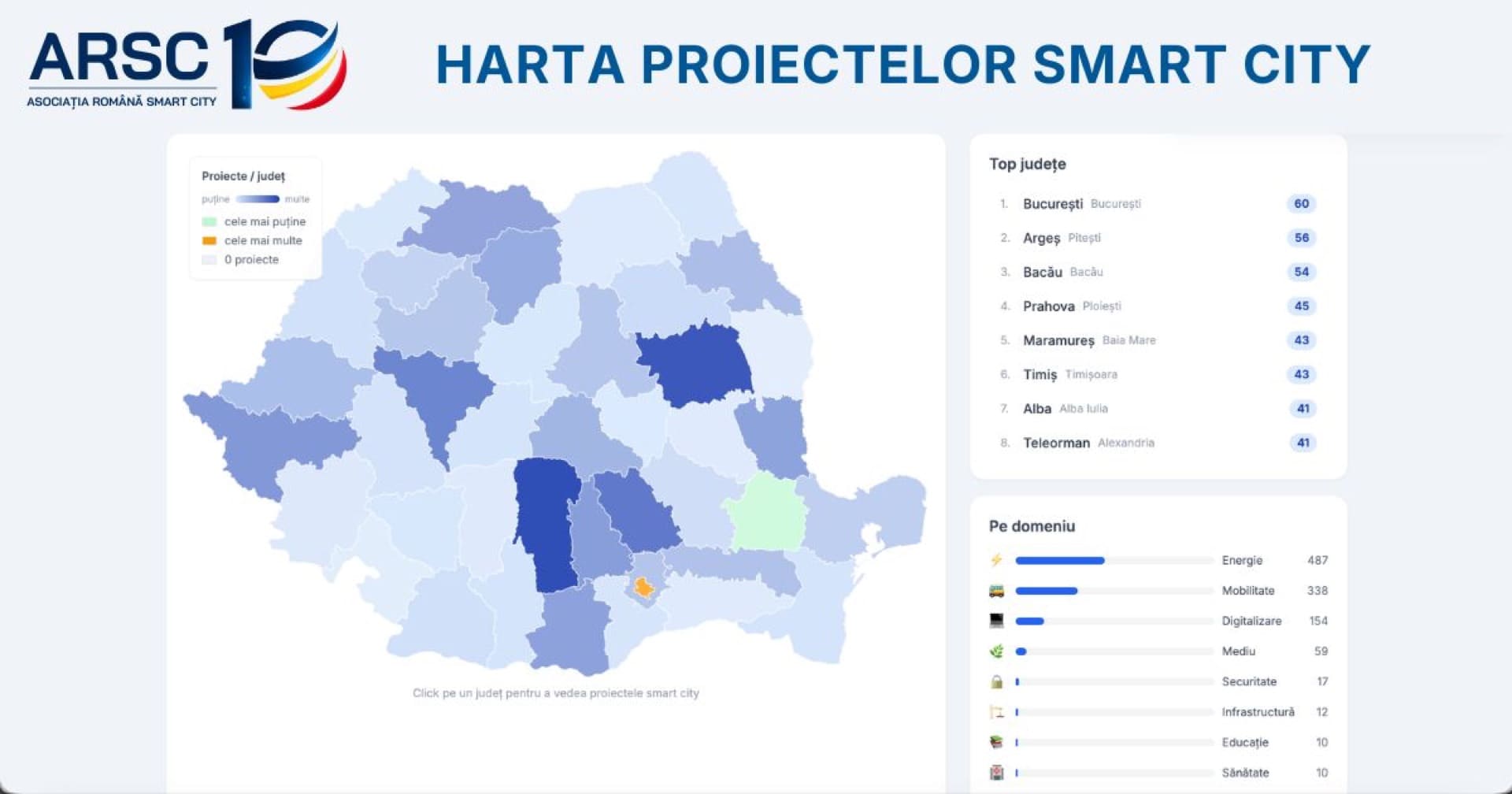
The current state of the Smart City market in Romania, with verified figures. Main source: ARSC's mapping on map.arsc.ro, updated continuously from official sources (PNRR, MySMIS, SEAP, INS, ANCOM, MIPE, MDLPA).

1,720Documented
projects
42Counties covered
(41 + the Municipality of Bucharest)
7Operational
fields
2,862Communes
(local authority reference)
216Towns
(local authority reference)
103Municipalities
(local authority reference)

The figures above are refreshed every time the site is published, straight from the ARSC database. The 1,720 projects are documented across the seven operational fields used in the ARSC database: Mobility, Digitalisation, Energy, Environment, Health, Education, Security. The sources are open: PNRR, MySMIS, SEAP, INS, ANCOM, MIPE, MDLPA, plus public mentions. For live figures by county and by category → map.arsc.ro.

Romanian cities with notable Smart City initiatives

An illustrative selection, not a ranking. For the full list by county, see map.arsc.ro (in Romanian).

CJ

Cluj-Napoca

Administrative digitalisation, ITS systems, an active start-up ecosystem.

AB

Alba Iulia

Romania's first Smart City pilot city (partnership with Orange, 2018).

B6

Bucharest · Sector 6

Urban mobility, digitalised public services, green infrastructure.

SB

Sibiu

Smart tourism, digital culture, e-Education at local level.

BH

Oradea

Energy efficiency in public buildings, smart lighting.

TM

Timișoara

European Capital of Culture 2023, with a related Smart City strategy.

See all projects on map.arsc.ro →
CHAPTER 10

Bibliography and
academic sources.

The 30 essential references for in-depth reading: official documents, academic studies, market reports and working tools. All checked, citable and available online.

Official EU documents

Market reports and indices

Foundational academic studies

  • Townsend, A. (2013). Smart Cities: Big Data, Civic Hackers, and the Quest for a New Utopia. W. W. Norton.
  • Greenfield, A. (2013). Against the Smart City. Do Projects.
  • Ratti, C. & Claudel, M. (2016). The City of Tomorrow. Yale University Press.
  • Caragliu, A., Del Bo, C., Nijkamp, P. (2011). Smart Cities in Europe. Journal of Urban Technology.
  • Albino, V., Berardi, U., Dangelico, R. M. (2015). Smart Cities: Definitions, Dimensions, Performance, and Initiatives. Journal of Urban Technology.

Romanian sources

Smart City in the Romanian context.

For a practical discussion with the ARSC team about how your community or organisation can benefit from the Smart City framework, book a meeting with our team.

The Smart City Romania network run by ARSC

Everything you want to know about the fastest-growing industry in Romania. The sites below are in Romanian.

arsc.ro · [email protected]